Waking Up at 3am in Perimenopause? How to Fix Your Sleep and Energy
Waking Up at 3am in Perimenopause? How to Fix Your Sleep and Energy
![[HERO] Waking Up at 3am in Perimenopause? How to Fix Your Sleep and Energy](https://cdn.marblism.com/0AtevqcA-HM.webp "[HERO] Waking Up at 3am in Perimenopause? How to Fix Your Sleep and Energy")
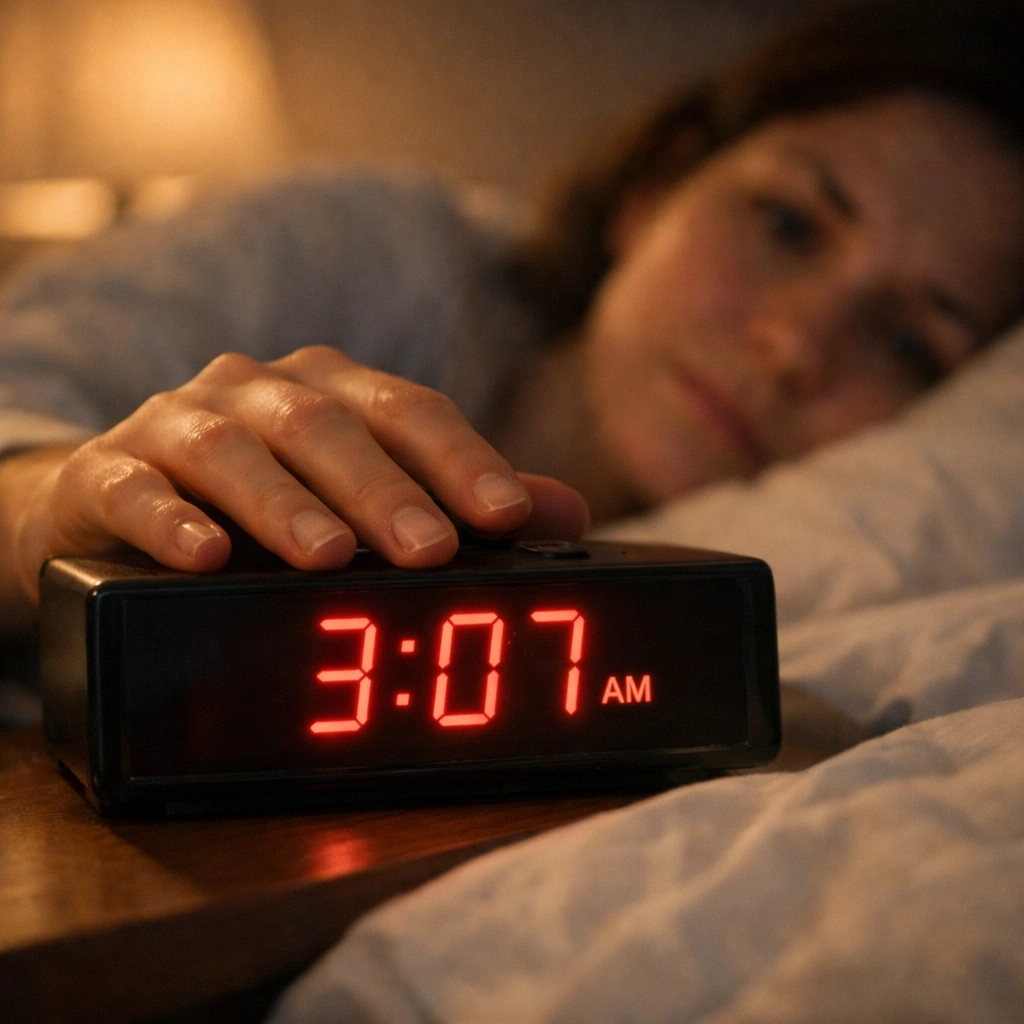
It's 3:07 AM.
Again.
You're wide awake. Your mind is spinning through tomorrow's presentation, the email you forgot to send, and whether you remembered to lock the back door. Your heart is racing slightly. You feel hot. Then cold. Then somehow both at once.
And underneath it all? That maddening sense of being completely wired but utterly exhausted.
If you're a professional woman navigating perimenopause, you already know this pattern too well. It's not "just stress." It's not because you had tea too late. And it's definitely not "just aging."
Your body is trying to tell you something.
Why Does 3 AM Feel Like Your Body's Alarm Clock?
Here's what's actually happening while you're staring at the ceiling, mentally rewriting your to-do list.
Your oestrogen levels, which used to be your sleep's best friend, are now fluctuating wildly. Oestrogen helps regulate your production of melatonin (your sleep hormone) and serotonin (your calm, happy hormone). When oestrogen dips, your entire sleep-wake cycle goes haywire.
But there's more.
Around 3-4 AM, your body naturally starts producing cortisol to prepare you for the day ahead. It's meant to be a gentle sunrise inside your system. But in perimenopause, especially if you're juggling a high-pressure job, family demands, and the general chaos of midlife, that cortisol surge can feel more like someone's thrown a bucket of cold water over you.
Your nervous system jolts you awake.
And if your blood sugar dropped overnight? (More on this in a moment.) Your body releases even more cortisol and adrenaline as an emergency response. It's basically screaming, "Wake up! We need fuel!"
You're not anxious because you woke up. You woke up because your hormones triggered an anxiety response.
The Blood Sugar Connection Nobody Warned You About
Let's talk about what you ate yesterday.
If your evening meal was light on protein or heavy on carbs (hello, pasta for dinner because you were too tired to cook), your blood glucose likely crashed somewhere around 2-3 AM. Your body interprets this drop as danger and floods your system with stress hormones to raise your blood sugar back up.
The result? You're suddenly awake, heart pounding, mind racing.
This is one of the biggest "aha!" moments I see with the women I work with. They've been told it's stress. Or caffeine. Or "just menopause."
But the root cause? It's often their Fuel.
In my FRESH Framework™, the F stands for Fuel: because what you eat directly impacts how you sleep. If you're not stabilising your blood sugar during the day and at your evening meal, you're setting yourself up for that 3 AM wake-up call.
What Else Is Keeping You Awake?
Beyond cortisol and blood sugar, perimenopause brings a whole playlist of sleep disruptors:
Night sweats and hot flashes. Declining oestrogen messes with your internal thermostat. One minute you're kicking off the duvet, the next you're freezing.
An overactive bladder. Lower oestrogen affects your bladder tone, meaning more trips to the bathroom at night.
Joint aches and restless legs. Inflammation rises as hormones shift, making it harder to get comfortable.
A nervous system stuck in "on" mode. If you've been running on adrenaline all day to keep up with work, meetings, and life admin, your body doesn't know how to switch off when your head finally hits the pillow.
The statistics don't lie: over 50% of women in perimenopause report insomnia. You are absolutely not alone in this.
But here's what's important: This is not something you just have to "live with."
The FRESH Strategy for Reclaiming Your Sleep (and Sanity)
Let me be clear: sleep in perimenopause isn't just about melatonin supplements or a new pillow. It's about addressing the root causes and supporting your body where it actually needs help.
In my FRESH Framework™, we focus on two key pillars for sleep: Fuel and Stress & Sleep (the S pillars). Here's how they work together.
1. Stabilise Your Evening Fuel
Your last meal of the day should be rich in protein and healthy fats. Think grilled salmon with roasted vegetables and a drizzle of olive oil. Or a chicken stir-fry with plenty of greens and avocado.
This keeps your blood glucose steady overnight and prevents that 3 AM cortisol spike. No more pasta-only dinners or toast before bed.
If you're someone who gets "hangry" or feels shaky when you haven't eaten, this is your sign that your blood sugar regulation needs support.
2. Cool Your Core
Your bedroom should feel like a sanctuary, not a sauna. Aim for around 18°C and invest in natural-fibre bedding (cotton, linen, bamboo). Consider a cooling pillow or even a small fan if night sweats are a regular guest.
Declining oestrogen means your body struggles to regulate temperature. Give it some help.
3. The Morning Light Trick
Here's something that sounds almost too simple to work: but it does.
Within 30 minutes of waking up, get outside for 10 minutes of natural light. No sunglasses. Just you and the daylight.
This resets your circadian rhythm and tells your brain exactly when to start producing melatonin later that evening. It's one of the most underrated tools for better sleep, and it costs you nothing.
4. Create a "Nervous System Bedtime"
If your mind is still in work mode at 10 PM, your body won't be ready for sleep at 11 PM.
Give your nervous system a wind-down window. This might look like:
No screens for 30-60 minutes before bed
A warm bath with magnesium salts
Five minutes of deep breathing or gentle stretching
Reading fiction (not work emails!) to shift your brain out of problem-solving mode
Your body needs to feel safe to sleep. If it's still in "high alert" mode from the day, it will keep waking you up to check for danger.

You Don't Have to White-Knuckle Your Way Through This
I know how it feels to drag yourself through the day on broken sleep. To reach for another coffee at 3 PM just to make it through a meeting. To snap at someone you love because you're running on fumes.
You can't perform at your best: personally or professionally: when you're this exhausted. And you shouldn't have to.
The 3 AM wake-ups aren't a life sentence. They're a signal.
When you address the root causes: your hormone balance, your blood sugar stability, your nervous system regulation: your sleep can improve. Not overnight (excuse the pun), but steadily, measurably, and in a way that actually lasts.
Ready to Stop the 3 AM Wake-Ups for Good?
If you're tired of piecing together advice from Google and Instagram and getting nowhere, it's time for a different approach.
In my 1-1 Lean On Lucy Programme, we look at the root cause of your sleep disruptions: not just the symptoms. Together, we create a bespoke plan that fits your life, your body, and your specific hormone picture.
No more guessing. No more exhaustion. Just clarity, support, and results.
👉 Get your sleep back with Lean On Lucy
Not sure where to start?
Let's have a chat and figure out exactly what's keeping you awake. In a private consultation, we'll map out your symptoms, identify the gaps in your current approach, and create a roadmap to get your energy: and your life: back.
👉 Book your private Consultation
You deserve to wake up feeling rested, clear-headed, and ready for the day. Let's make that happen.


